Areas we cover across London
We work from our workshop at 6 Atlas Road, Wembley HA9 0JH, across Greater London and the near Hertfordshire border.
Core coverage
Where most of our work is
Being based in Wembley means north, west and central London are on our doorstep. These are the areas we are in most weeks.
- Wembley
- Harrow
- Brent
- Ealing
- Camden
- Westminster
- Kensington & Chelsea
- Hammersmith & Fulham
- Barnet
- Islington
- City of London
- Watford
Full list
Every area we survey and install in
- Wembley
- Harrow
- Brent
- Ealing
- Acton
- Willesden
- Kilburn
- Camden
- Islington
- Westminster
- Marylebone
- Fitzrovia
- Mayfair
- Kensington
- Chelsea
- Hammersmith
- Fulham
- Chiswick
- Shepherd's Bush
- Notting Hill
- Maida Vale
- St John's Wood
- Hampstead
- Highgate
- Finchley
- Barnet
- Mill Hill
- Edgware
- Stanmore
- Pinner
- Northwood
- Ruislip
- Uxbridge
- Hayes
- Southall
- Greenford
- Wood Green
- Enfield
- Walthamstow
- Hackney
- Shoreditch
- City of London
- Clerkenwell
- Southwark
- Battersea
- Wandsworth
- Richmond
- Twickenham
- Kingston
- Watford
- Bushey
- Borehamwood
Not on the list? If you are within the M25 it is worth a call. We travel for larger projects and can usually fit a survey around work already booked nearby.
What we do across these areas
- Slim double glazing for sash windows
- Replacing the glass in a sash window, pane by pane
- Should you put double glazed glass in your sash windows?
- Repairing sash window glazing without replacing the glass
- Heritage glass in sash windows: what you have and what to do with it
- Sash window glass across London, and what each part of the city throws at you
- Ordering replacement panes for a sash window
Where London's period windows are, and how that changes the job
We work on sash window glass in London from the Wembley workshop, right across Greater London, and most intensively in the north, west and centre. Period glazing is not spread evenly across the city. It sits in bands of housing built at particular moments, overlaid with a patchwork of conservation areas, Article 4 directions and listed buildings that varies street by street. Where your house falls in that pattern decides what can be specified, what has to be applied for, and how the glass physically gets to the window.
Central London: listed terraces and no room to work
Westminster, Kensington and Chelsea and the City hold the highest concentration of listed facades in the country, and the stucco-fronted terraces of Pimlico, Belgravia, Marylebone and Bloomsbury are where consent risk is at its greatest. These windows are often fine six-over-six or margin-light sashes with slender bars, and a surprising amount of original crown and cylinder glass survives in upper floors where nobody has had reason to touch it. On buildings like these the correct answer is frequently the conservative one: retain, repair, draught proof, replace only the panes already lost, and leave the glazing pattern exactly as it is.
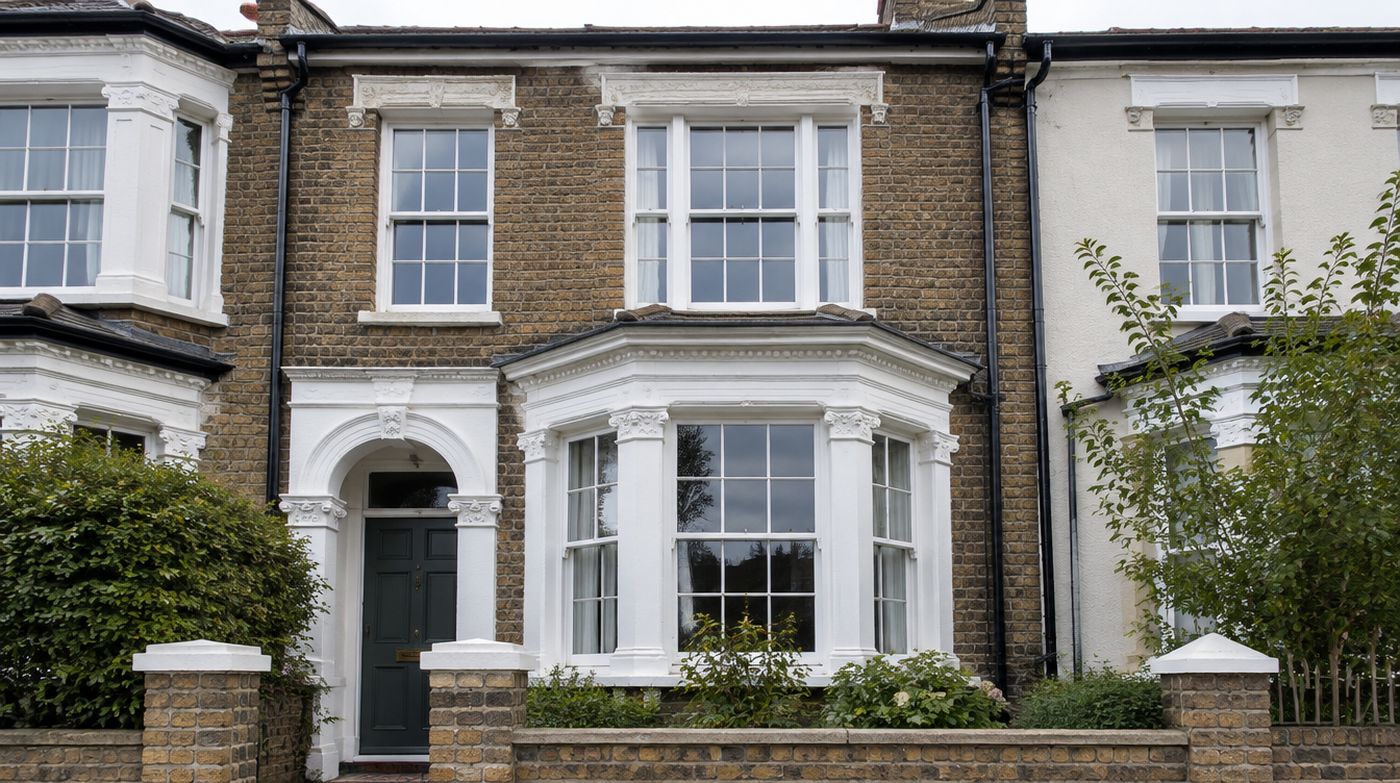
Access is the other defining feature. There is no side return, no front garden to stand a tower in, and the pavement is highway, so any scaffold or tower outside needs a licence from the highway authority and some boroughs are slow about granting one. Our default in central London is therefore to work from inside, taking the sashes out of the room the way the window was designed to be maintained. Where the staircase is narrow and cantilevered, as it is in most Georgian houses, a large sash cannot be carried down it, so the glass and the sash go out through the opening instead, which needs planning on the day rather than improvisation.
Parking suspensions take several working days to arrange in central boroughs and cost real money. Red routes cannot be suspended at all, so vans unload and move. Congestion Charge and ULEZ apply to every visit. None of that is interesting, but it is why a central London survey takes longer to schedule than one in Ealing and why access shows up as its own line in our quotations.
Georgian and early Victorian stock: Islington, Hackney, Spitalfields, Greenwich, Camberwell
Barnsbury and Canonbury in Islington, De Beauvoir Town in Hackney, Fournier Street and Elder Street in Spitalfields, the streets behind the Royal Naval College in Greenwich West, and Camberwell Grove and Addington Square in Southwark. This is the oldest surviving domestic stock in volume, and the windows are the most delicate we handle: thin bars, small panes, sashes that are often original timber with original glass still in them.
A detail worth knowing is that the London Building Acts progressively pushed window frames back behind the face of the brickwork, so the earliest houses have frames set almost flush while later Georgian work has them recessed in a reveal. That changes how deep the sash sits, how much weather it takes, and how much room there is to work from outside. On the flush-framed houses there is effectively nothing to stand on and the reveal gives no protection, which is another reason work happens from inside.
Conservation pressure here is high and Article 4 directions are common, so front elevations are usually off limits for any visible change. In practice we often propose keeping the multi-pane front lights single glazed with their original glass, carrying out thorough draught proofing and cord and weight overhaul, and putting slim units only in rear elevations or in later sashes where panes are larger and the bar widths can absorb it. Front light wells, railings and basement areas also mean a ladder cannot be safely footed at the front of these houses, which rules out the quick option before anybody suggests it.
Victorian terraces: Camden, Fulham, Wandsworth, Walthamstow, Peckham
Kentish Town and Tufnell Park in Camden, Parsons Green and the Munster Village streets in Fulham, the Tonsleys in Wandsworth and the Shaftesbury Estate in Battersea, Walthamstow Village and the Warner estates in Waltham Forest, Holly Grove and Lyndhurst Way in Peckham. Mid to late Victorian terraces with two-over-two sashes, horns at the meeting rails and large panes. These are the best candidates in London for slim double glazing, because the bar widths are generous, the panes are big enough for the glazing to make a difference, and the sashes are substantial enough to carry the extra weight once the weights are adjusted.
Ground floor bays are the common complication. A canted bay has splayed side lights that are not square and never were, which is exactly the sort of pane a workshop that cuts its own glass handles easily and a stock supplier does not. The flat or tiled roof over a bay sometimes gives a working position for the first floor window above it, and sometimes will not take the weight, which is a judgement made at survey and not on the phone.
Waltham Forest's Warner houses deserve a particular mention because they are divided as upper and lower maisonettes with separate front doors, so a single window elevation can involve two households and two owners. We have had jobs where the ground floor wanted draught proofing and the first floor wanted sealed units in the same facade. If that is your situation, agree the specification between you before anybody quotes, because matching glazing across an elevation is often a conservation condition as well as common sense.
On access, these are controlled parking zones almost without exception. A suspension is usually arranged a few working days ahead through the borough and carries a fee, and we handle that or tell you to. With no side access, every pane and every sash travels through the hall, so floors get protected and the hall width is measured at survey. In a narrow terrace with a half-landing turn, a large staircase sash sometimes physically cannot come through the house and has to leave through its own opening.
Edwardian and interwar stock: Ealing, Chiswick, Dulwich, Muswell Hill
Edwardian houses are the easiest period property we work on, and the reason is the window design itself. The typical bay has a plain single-pane lower light with a decorative multi-pane or leaded top light above it. That split is a gift. The large lower pane is a straightforward candidate for a slim sealed unit, while the top light with its coloured margins or leaded pattern is left exactly as it is. You get most of the thermal benefit with none of the argument about bar widths, and the decorative glass that gives these streets their character stays where it belongs.
Bedford Park in Chiswick, Brentham Garden Suburb in Ealing, Rookfield in Muswell Hill and Hampstead Garden Suburb all carry strong conservation designations, and two of them bring a second layer of control. The Dulwich Estate operates a scheme of management across much of Dulwich Village and the surrounding roads, and Hampstead Garden Suburb has its own trust. Both can require consent for window alterations independently of the borough's planning decision. Getting planning permission and then discovering a separate estate consent was needed is a painful and entirely avoidable sequence, so we check for it at survey.
Physically these are good houses to work on. Side returns and rear gardens mean a tower or a light scaffold can usually be built off solid ground at the back, and a front garden means we are not standing on a pavement and are not applying for a licence to do it. The 1930s semis further out in Ealing, Finchley, Harrow, Bromley and Sutton bring their own quirk: curved and faceted bay windows, often with metal casements set into timber subframes, where the question is usually whether the frame is worth glazing at all before we talk about what goes in it.
Mansion blocks, conversions and the consent nobody expects
Mansion blocks in Maida Vale, Marylebone, West Hampstead, Earl's Court, Battersea and Streatham are a category of their own, because the windows are rarely entirely yours. Most leases make the frames the freeholder's responsibility and some make the glass the leaseholder's, and many require that all windows in the block match. A single flat fitting slim units while its neighbours stay single glazed can be refused on uniformity grounds alone, regardless of planning.
So the order of work changes. Before we survey a flat in a block, get your lease checked for who owns the window and the managing agent's written consent or a licence for alterations. Some blocks will only permit a building-wide programme, in which case the useful conversation is with the residents' association rather than with us. We are glad to provide the technical specification for a block-wide proposal, and we would rather do that than survey a flat whose owner is going to be refused.
The practical side of block work is all logistics: goods lift dimensions and booking slots, protection of communal stairs and lifts, permitted working hours set by the building rather than by us, and the insurance certificates, risk assessments and method statements managing agents require before anybody arrives. We supply those as a matter of course. Windows facing an internal lightwell are a special case, since no scaffold is possible and everything, including sash removal and refitting, has to be done from inside the flat.
Estate and housing association property
A great deal of London's period housing is owned by councils and housing associations, including Georgian and Victorian conversions in Islington, Hackney, Southwark, Lambeth and Camden. If you are a leaseholder in a converted period house with the council as freeholder, window replacement almost always needs the freeholder's consent and may have to follow their own specification. It is also worth asking whether windows are included in any planned major works programme, because paying for your own glazing a year before a scheme replaces the lot is a bad outcome that one phone call prevents.
Working at height on a terraced street
Our starting assumption on any period sash is that the work happens from inside. A box sash was designed to be maintained from the room: beads off, sashes out, cords untied, everything on the floor on a dust sheet. That avoids scaffold cost, avoids licences, and is usually safer. Scaffold or a tower becomes necessary where new sashes are being installed in a repaired frame, where the frame itself or the external cill needs work, where a light is fixed rather than sliding, and on some bay configurations where a sash cannot be brought inwards.
Scaffold on a pavement or carriageway needs a licence from the borough, with notice, insurance and sometimes night lighting and a hoarding. In a narrow terraced street with cars both sides there may be no safe standing at all without a suspension. This is the part of a glazing job that homeowners never budget for and that varies more between Camden and Croydon than the glass itself ever does.
One more honest note on weather. We will not carry or fit large panes in high wind. A sheet of glass is a sail, and a terraced front path in a gusting south-westerly is where people get hurt. If a day gets moved for wind, that is a real reason and not an excuse.
What happens to your house while a window is out
When sashes come back to the workshop the opening is boarded with ply or OSB screwed into the rebate, insulated behind and sealed at the edges, so the room stays usable and reasonably warm. We board one room at a time wherever the programme allows, rather than opening up a whole floor. Boards on ground floor openings are fixed from inside, and on a street where an overnight boarded opening is a genuine security concern we agree the arrangement with you before we start rather than after.
Sashes are labelled by room and elevation, beads are kept, fasteners and pulleys are bagged with the sash they came from, and the number of nights each opening will be boarded is written in the quotation. Old putty comes off with heat and hand tools at the workshop, not with a sander in your front room, for the lead paint reason set out on our about page. Expect dust where sashes are removed, expect a day where the room is not usable, and expect us to tell you which day that is in advance.
Site surveys are free across Greater London and we quote in writing. If you want to talk through what is realistic for your street, your borough and your particular windows, call 020 4634 6045 between 8am and 5pm, Monday to Friday.
Get an honest answer about your sashes
Send a photo of the window and the glazing bar layout. We survey across London and will tell you plainly what the window can take.