Replacing the glass in a sash window, pane by pane
A broken pane in a timber sash is a small job done carefully or an expensive one done badly. This page is about what actually happens at the window.
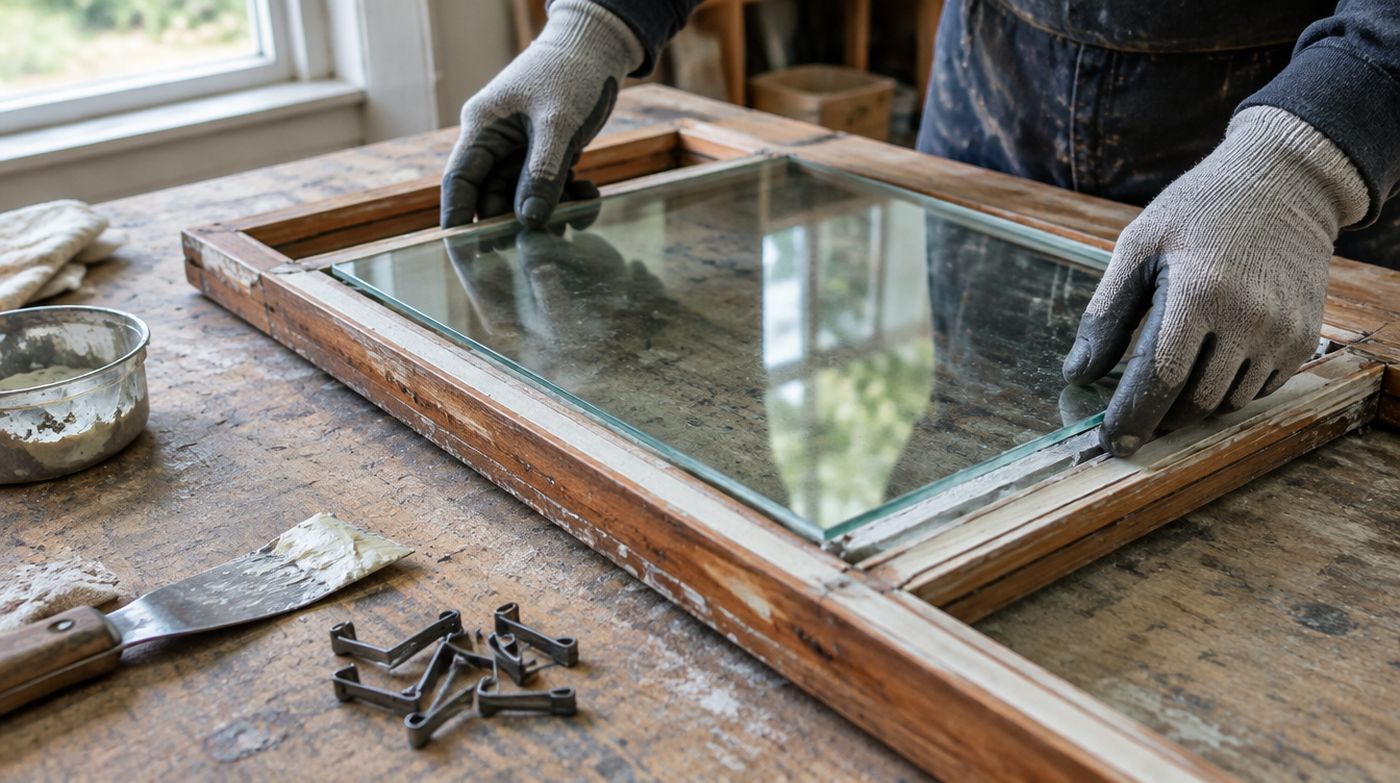
What a sash window glass replacement actually involves
A sash window glass replacement is four jobs, not one, and most quotations only describe the first. The broken pane and its putty come out. The rebate is cleaned back to sound timber, probed for rot and primed. The new glass is bedded, pinned and puttied. Then the putty is left to skin and the pane is painted. Leave out any one of those four and you will be looking at the same window again within a few years.
The glass itself is the cheap part. A pane of clear float cut and arrissed in our Wembley workshop costs very little, and because we cut it ourselves there is no merchant sitting in the middle of the price. What costs money is the hour or two spent at the window, the care taken not to damage the things around the pane, and the return visit to paint. If a price arrives that is only about glass, it has come from somebody who has priced a sheet of material rather than a window.
Taking the sash out, or glazing it where it hangs
There are two ways to do this and they are not interchangeable. The sash can come out of the box, go flat on a bench or a pair of trestles and be glazed horizontally. Or it can be glazed in situ, standing at the window with the sash where it is.
Bench work gives the better result. Gravity holds the glass down into the back putty while you work, the front putty can be cut in one clean run, and you can see the whole rebate at once. The cost is disturbance. To get the bottom sash out you remove the staff bead, which is usually nailed and painted in and has to be eased off without splitting. To get the top sash out you also have to take out the parting bead, which is thin, often brittle and frequently the thing that breaks. Both sashes hang on cords, and a cord that is forty years old and sun bleached will sometimes let go the moment you handle it.
In situ glazing avoids all of that. For a single pane in the bottom sash of a two over two, reachable from inside the room, it is often the right call. The putty line takes longer to cut well and you are working against gravity, but nothing else in the window is touched.
So the honest question to put to a glazier is which of the two they are proposing and why. If the answer is that every sash in the house has to come out to replace one pane, ask what that is for. And ask what happens if a cord goes while a sash is out, because that is a separate job with a separate price, and you want the number before it happens rather than after.
Raking out old putty without destroying the rebate
Linseed oil putty that has been in a London window since the 1930s is not really putty any more. It has oxidised into something closer to a hard mineral, bonded to both the timber and the glass and locked under layers of paint. It does not scrape off. It has to be cut out with a hacking knife, or softened with gentle heat and then cut out.
The thing being protected during that process is the rebate. On a softwood sash the rebate is a shallow step, often under 10mm deep, and its outer edge is a thin arris of timber carrying all the paint. Lever against it with a chisel and it tears away in short lengths. Once that has happened the new putty has nothing to form a bevel against, and the repair looks wrong from the street for the rest of its life.
This is also the moment the real condition of the window reveals itself. The bottom rail, and the joint where the bottom rail meets the stile, is where water has sat for decades. If a screwdriver goes into that timber without resistance you have found the actual problem. Glazing a new pane into a rotten rail is money set on fire, and we would rather say that on survey than take the glazing job and leave the rot for somebody else to find.
The pane next to the broken one is the fragile one
The glass most likely to break during a sash window glass replacement is not the pane being replaced. It is the pane beside it. Old glass is thin, roughly 2 to 3mm, and it varies in thickness across its own area. It has usually been under quiet stress for a century from paint build-up and hardened putty gripping its edges. Hacking putty sends vibration straight along the glazing bar into whatever sits on the other side.
That matters more than it sounds. If the surviving pane is cylinder or early drawn glass it cannot be bought back. There is no stock of it anywhere. You can buy something that resembles it, which is a different thing. So the sequence is to work the putty away from the bar rather than towards it, support the glass from behind with a hand or a block, keep any heat low and local, and accept that the job takes longer than it looks.
It is a fair question to ask anybody quoting: what do you do if you break an original pane while working? The answer tells you whether they are treating the window as an object or as a unit of billable work.
Paint on a pre-1970s sash should be treated as lead paint
Sash windows in London carry a remarkable amount of paint. Ten or twelve coats is normal on a Victorian terrace and the lower coats are old. Lead compounds were used in decorative paint through most of the twentieth century and were not properly restricted in British retail paint until the early 1990s. Intact paint sitting on a window is not the hazard. Dust and fume are the hazard, and both are created by the way the paint is taken off.
In practice that rules out dry sanding, orbital sanders, angle grinders and burning off with a blowtorch on any old window, and it rules them out absolutely in an occupied house with small children in it. Wet abrasion, chemical stripper or infrared at a controlled temperature are the sensible options, with dust sheets down and the debris collected rather than swept into the room.
There is a commercial point buried in this as well. Some quotations for one cracked pane arrive with a full strip back to bare timber attached. That is a redecoration job stapled to a glazing job. If you want the window stripped and repainted, buy it deliberately and price it separately. If you want a pane replaced, the paint only needs cutting back where the putty is coming out.
Bedding, sprigging and the curing time nobody mentions
The glass is set on a thin continuous bed of putty laid into the rebate and pressed down until it beds evenly, then held with sprigs or glazing pins tapped into the timber at roughly 300mm intervals and left flush so the front putty covers them. The front putty is cut to a bevel running from the face of the glass to the outer edge of the rebate, finishing below the line of the internal rebate so that no putty is visible from inside the room. That line is the entire visual quality of the job.
Then it has to be left alone. Linseed oil putty cures by oxidation from the outside in. It needs to form a firm skin before it will take paint, and in warm dry weather that is a week or two. In a cold damp London January it is longer and there is no way to hurry it. Paint it too early and the paint film sits on soft putty and cracks. Never paint it at all and the putty dries out, shrinks and parts from the glass within a couple of years.
When the paint does go on it has to lap about 2mm onto the glass. That tiny overlap is what seals the joint between putty and glass against rain. A beautifully cut bevel with the paint stopped short of the glass will fail faster than a rough one that was lapped properly.
Which means the job is honestly two visits, or one visit plus something you finish yourself. You should be told which. Anybody who putties and paints within the same hour has either used an acrylic glazing compound, which is a legitimate choice and should be stated on the quotation, or has sealed uncured oil putty under paint and will be long gone by the time it shows.
Timing, weather and why winter changes the job
Glazing a sash in February is not the same job as glazing it in June. Cold glass is more sensitive to local heat, so softening old putty with a hot air gun needs more patience and more distance. Fresh putty handles stiffly below about 10°C and tears rather than cutting cleanly. Curing is slower, so the painting visit moves further out and the putty sits exposed in the meantime.
None of that is a reason to live with a broken pane and the weather coming into the house until spring. It is a reason to expect the painting to be scheduled properly rather than promised for the same week, and a reason to be suspicious of a January quotation that claims the whole thing will be finished and painted in a single morning.
If the sash already has a sealed unit in it
Plenty of London sashes were converted at some point and now hold a small double glazed unit in a timber bead rather than a single pane in putty. When one of those mists up the repair is different. The bead comes off, the failed unit comes out, a new unit is made to the measured size, and the real question becomes whether the original conversion left enough rebate depth to do the job properly or whether somebody butchered the sash to make a thick unit fit.
That work we do. What we do not do is misted double glazing in modern uPVC frames. It is a volume job with different gaskets, different fittings and different economics, and it is handled by a sister operation rather than by a workshop set up for period timber. If that is what you have you will get a better price and a faster visit from people who do it all day.
Where not to spend money on a single pane
- A hairline crack that is stable, is not in a low-level pane and is not letting water in. Mark the ends of it with a pencil, look again in six months, and spend the money when it actually moves.
- Replacing every pane in a light so that they all match. It is expensive, and it throws away original glass to fix something most people stop noticing within a fortnight of living with it.
- Toughened glass high in a top sash where there is no critical location to satisfy. It costs more, it cannot be cut once processed, and it carries a faint surface distortion that shows up on a sunny day.
- Scaffolding for one first floor pane that can be reached and glazed from inside the room.
- Any quotation where the glass is itemised and the raking out, priming, puttying and painting are not mentioned at all.
And one more, which is the biggest of them. If the real complaint is that the room is cold and draughty rather than that a pane is broken, glass replacement will not fix it. The air is coming past the meeting rail and around the edges of the sashes, not through the glass. Our glazing repair page covers what can be put right without new glass, and in most period houses draught proofing is both the cheaper and the larger win.
FAQ
Questions about sash window glass replacement
How long does it take to replace the glass in a sash window?
The glazing itself is usually an hour to two hours per pane, plus time to get the sash out and back in if it is being bench glazed. Where it stretches is the curing. Linseed oil putty needs a week or two of reasonable weather to skin before it can be painted, and longer in a cold damp spell, so a properly finished pane involves a second visit for the paint. Expect one working visit now and a short painting visit later, rather than a single morning that ends with wet paint on soft putty.
Can you replace sash window glass without taking the window out?
Often yes. A single pane in the bottom sash, reachable from inside, can be glazed in situ with nothing else in the window disturbed. That is frequently the better choice because taking a sash out means removing staff and parting beads and handling old cords, both of which can create more work than the pane did. The trade-off is that a putty bevel is harder to cut cleanly working vertically. Panes in a top sash, large heavy panes and anything shaped are usually better taken out and glazed flat on a bench.
Do I need building regulations approval to replace one pane of glass?
Replacing a pane in an existing frame is a repair and is not a controlled fitting, so there is no notification and no FENSA certificate involved. Replacing the whole window is different: that is a controlled fitting and needs either a registered installer such as ourselves or a building control application. The glass specification rules still apply either way. If the pane sits in a critical location under Approved Document K, broadly below 800mm from floor level in a window, it has to be safety glass regardless of whether the work is notifiable. Listed buildings have their own consent requirements on top.
Get an honest answer about your sashes
Send a photo of the window and the glazing bar layout. We survey across London and will tell you plainly what the window can take.