Heritage glass in sash windows: what you have and what to do with it
Old window glass can be dated by the way it was made, and once you can read it the decisions about keeping, moving or replacing a pane become much easier.
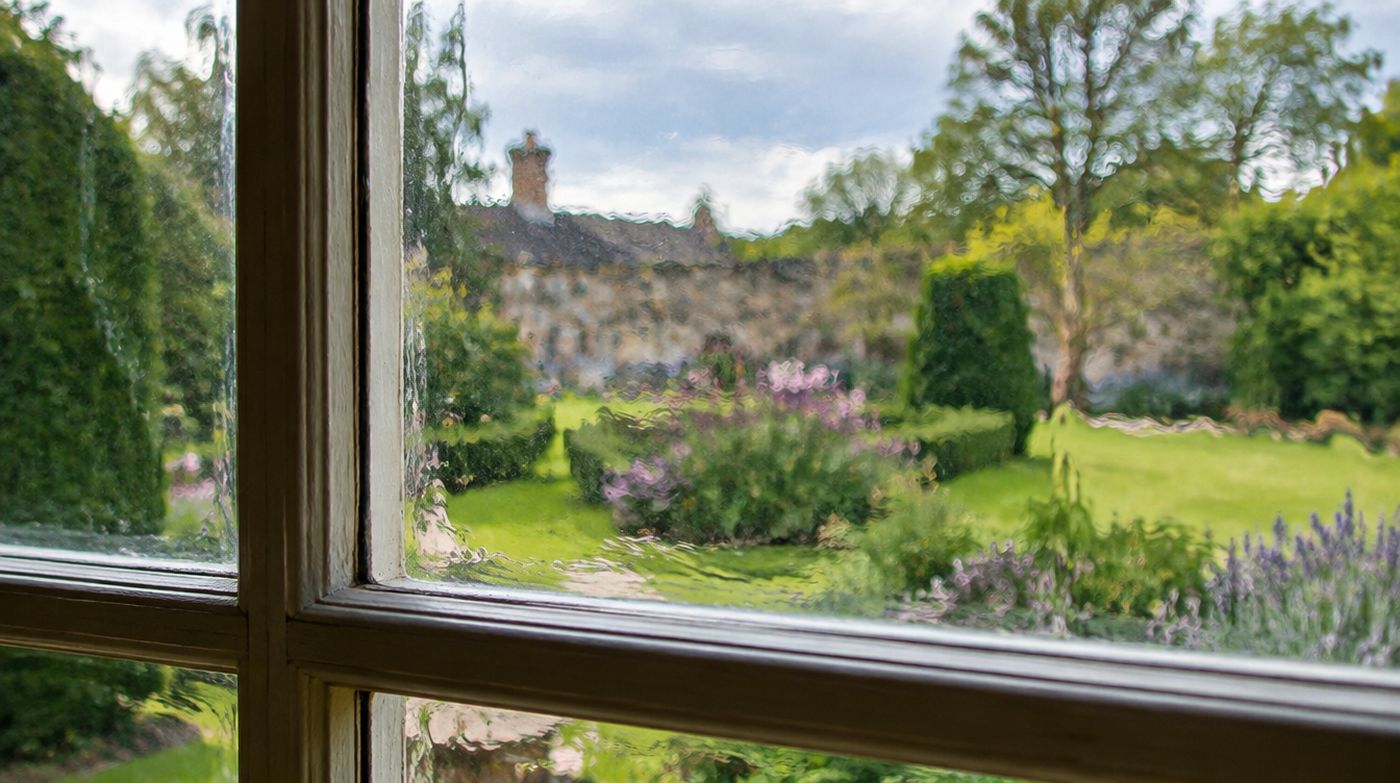
Heritage sash window glass is a record of a manufacturing process
There is no such thing as heritage sash window glass as a product you can order by name. What people mean by the phrase is glass made before the float process, and the reason it looks the way it does is that every method before float left the surface slightly uneven. Modern float glass is formed on a bath of molten tin, which is why a modern pane reflects a straight line as a straight line. Everything earlier reflects it as a line that moves as you move.
That distortion is not a defect and it is not decoration either. It is a by-product of manufacture, and its character changes with the method, which is exactly what lets you date a pane roughly by eye. Knowing the method also tells you how thick the glass is likely to be, how fragile it is, and whether it can be reused somewhere else in the building.
Crown glass, and the bullseye everybody has heard of
Crown glass was spun. A gather of molten glass was blown, opened out and spun on an iron rod until centrifugal force flattened it into a disc, which could be a metre or so across. The disc was then cut into panes. It was the standard good glazing in Britain through the eighteenth century and into the 1830s.
Two things follow from that. The distortion runs in gentle concentric curves, because that is the direction the glass flowed, and the thickness varies across the disc. And the panes cut from a disc are necessarily small, which is a large part of why Georgian sashes are six over six or eight over eight rather than two big panes. The window pattern follows the glass technology, not the other way round.
The centre of the disc, where the rod was attached, is the thick lumpy bullion that everyone calls a bullseye. It was the offcut. It was the cheapest part of the sheet and it went into outbuildings, cellars, stores and the occasional fanlight, not into the front elevation of a good house. So a bullseye set proudly in the middle of a Georgian front window is almost always a modern affectation. If somebody offers you one as a period detail, they are selling you an anachronism at a premium.
Cylinder glass: the long blown sheets of the nineteenth century
From the 1830s, cylinder or broad glass took over. A long cylinder was blown, the ends cut off, the cylinder split lengthways, then reheated and flattened into a sheet. It could be made very much larger than crown, and that single fact changed the look of London. Remove the need for small panes and the glazing bars go with it, which is why the terraces built between roughly 1840 and 1870 move from multi-pane Georgian lights to the two over two sash with horns.
Cylinder glass distorts in long parallel lines running in the direction the cylinder was flattened. Look at a window frame across the road through it and the reflection ripples along one axis rather than in curves. It is thin, usually around 2mm, and it often carries small elongated bubbles and faint marks from the flattening table.
This is the glass still surviving in most unaltered Victorian sashes across London, and it is the glass most often thrown into a skip without anybody looking at it first.
Polished plate: the flat expensive option
Running alongside the blown glasses was cast plate: glass poured onto a table, then ground and polished flat on both faces. It was laborious and expensive, and it was what you specified for a large shop window, a grand stair window or the principal elevation of a costly house.
Polished plate is flat and thick, often 5 or 6mm, with a slight green cast visible in the edge. People regularly mistake it for modern glass and conclude the window has been reglazed at some point, when in fact they are looking at the original and the most expensive glass in the building. Before deciding, look at the edge where it sits in the rebate and look across the surface in raking light for any remaining sign of grinding.
Drawn sheet: 1900 to the arrival of float
From the early twentieth century glass was drawn mechanically in a continuous ribbon. Drawn sheet is far more consistent than anything blown but it is not flat, and it carries a fine distortion running in one direction with a faintly striated quality. It is what you find in Edwardian and interwar sashes and casements across the outer boroughs, and in replacement panes fitted to older windows at any point before the 1960s.
Float glass was developed by Pilkington at the end of the 1950s and had taken over ordinary glazing within about a decade. That gives a reliable rule of thumb that settles most arguments about whether a window is original: if a pane is perfectly flat with no movement in the reflection at all, it was almost certainly made after 1960, whatever the age of the frame around it.
Reading your own windows in daylight
You do not need to take anything apart. Stand inside in daylight and look through each pane at something with a long straight edge some distance away, a gutter line, a lamp post or a window frame opposite. Then move your head slowly from side to side and watch what the reflection does.
Flat and still means float, so post-1960. Rippling along one axis means cylinder or drawn sheet, and drawn sheet is the finer and more regular of the two. Gentle curved movement with visible variation in thickness means crown. Thick, flat and slightly green at the edge in a large Victorian light is probably polished plate. Then look for bubbles, seeds and fine linear marks, and feel the thickness at the edge if you can reach it.
You will almost always find a mixture. A typical London terrace has original glass in the panes nobody ever hit, 1970s float where a ball went through, and something in between where a sash was repaired before the war. That mixture is the actual object you are making decisions about, and it is worth writing down pane by pane before anybody quotes you for anything.
Keeping it: shuffling panes and the salvage question
The conservation principle is short and worth stating plainly. Original glass that is sound should stay in the building. It cannot be remade, it is a real part of why the house looks as old as it is, and removing it is a one-way decision.
In practice that leads to three useful tactics. The first is shuffling. If a pane breaks on the front elevation and there is original glass in a rear or side light that nobody looks at, the surviving old pane can be moved to the visible position and the new modern pane fitted at the back. That costs two glazing operations instead of one and gives a better result than any reproduction glass will.
The second is salvage. Old glass that comes out of a window during other work should not go in a skip. We keep what comes out of our own jobs, sorted by type and thickness, and we will cut from it where a pane can genuinely be matched. Architectural salvage yards hold it as well. The limits are honest ones: salvaged old glass is thin, varies in thickness across a single sheet, has usually been cut more than once already, and cannot be toughened. So it will not go into a critical location and it will not go into a sealed unit.
The third is to resist the matching instinct. If one pane in a six over six has to be modern, a single modern pane among five old ones is far less noticeable from inside the room than you expect, and from the pavement the difference in a top sash is barely readable at all. The temptation is to replace all six so that they match. That trades five irreplaceable panes for visual tidiness, and we will argue against it every time.
When a reproduction is the honest answer
Sometimes there is no old glass to use. Reproduction restoration glass is made by drawing or by hand specifically to carry distortion, and the better ones are convincing. Used properly they belong in a whole light that has already lost all of its original glazing, in a new sash made to replace one beyond repair, or in a listed building where a conservation officer has asked for a sympathetic match rather than a salvaged one.
Two cautions. Reproduction glass with a heavy exaggerated ripple reads as decorative rather than old, and set next to genuine cylinder glass it looks wrong in a way that is hard to unsee afterwards. And restoration glass inside a slim sealed unit is a compromise by definition, because an uneven pane is being bonded to a flat one around a spacer. It can be done and we do it, but a double glazed sash will never behave optically like a single old pane and nobody should promise you that it will.
Where heritage glass money gets wasted
- Paying a restoration glass premium on a rear elevation, a basement light, a side return or anywhere nobody stands and looks at the window.
- Buying a bullion or bullseye pane as a period feature for a front window. It was the cheap offcut of the disc and it was never used that way.
- Replacing a whole light of original glass because one pane has a chip in a corner that sits under the putty.
- Specifying heavily textured reproduction glass on an Edwardian house, where the original was most likely fine drawn sheet with only slight movement in it.
- Any heritage premium with no statement of what the glass actually is. Ask which process, what thickness, and whether it is salvaged or newly made. If the answer is just the word heritage, you are paying for a word.
And the answer we give on this subject more often than any other: leave it alone. Original glass sitting in a sound putty line, repainted when it needs it, will comfortably outlast everything else in the window. Most of what people want to spend on heritage sash window glass is better spent on the timber and the paint that keeps the old glass where it is.
FAQ
Questions about heritage sash window glass
How can I tell if my sash window glass is original?
Look through each pane in daylight at something with a long straight edge well in the distance, then move your head from side to side. If the reflection stays perfectly straight and still, the glass is float and was made after about 1960, whatever the age of the frame. Movement along one axis suggests cylinder or drawn sheet glass, so nineteenth or early twentieth century. Gentle curved movement with uneven thickness suggests crown glass, so pre-1840. Small elongated bubbles and faint linear marks from manufacture are good supporting signs. Most houses turn out to hold a mixture, pane by pane.
What is the difference between crown glass and cylinder glass?
They were made differently and they look different. Crown glass was blown and then spun flat into a disc, so the distortion runs in gentle concentric curves, the thickness varies across the sheet, and the panes cut from it are small. That is why Georgian sashes have many small panes. Cylinder glass, from the 1830s onwards, was blown as a long cylinder, split and flattened, so the distortion runs in long parallel lines in one direction and much larger panes were possible. The move to cylinder glass is the reason Victorian sashes lost their glazing bars and became two over two.
Can original sash window glass be reused in a new frame?
Often yes, and it is usually the best result available. Sound old panes taken out during repair work can be bedded into a repaired or newly made sash, and a pane from a rear light can be moved to a visible front position. The limits are practical. Old glass is thin and uneven, so it needs a rebate cut to suit it and careful glazing. It cannot be toughened, so it cannot go into a critical location below about 800mm from floor level. And it will not go into a sealed unit. Keep anything that comes out rather than skipping it.
Get an honest answer about your sashes
Send a photo of the window and the glazing bar layout. We survey across London and will tell you plainly what the window can take.